

What Are Protection Relays and How Do They Work?
Protection relays are an integral component of electrical infrastructure. This overview of relay components is to help facility managers, maintenance technicians, safety officers and other professionals gain a better understanding of what protection relays are, how they work and why they’re essential for electrical safety in commercial and industrial locations. We’ll examine how relay types differ in their applications, and we’ll look at major advancements in today’s smart relay technology and how those are improving the overall performance of relay systems.
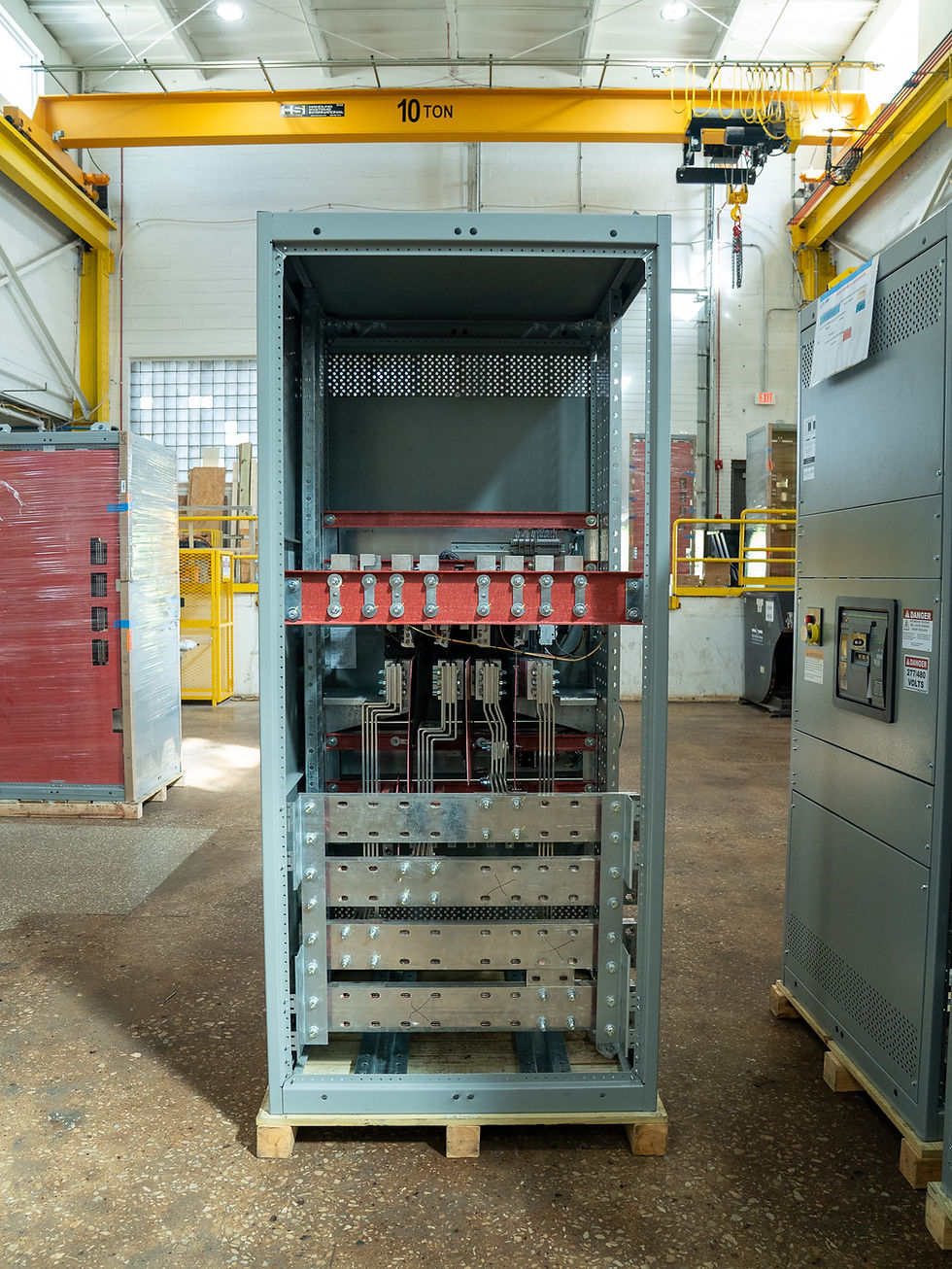
At DuFab Manufacturing, protection relays are among the critical components housed inside the prefabricated electrical rooms and E-houses we build for industrial and commercial facilities. Understanding how they work is central to why proper prefabrication and controlled assembly matter so much.
Introduction to Protection Relays
Protective relays are devices designed to continuously monitor electrical safety systems and react to abnormal operating conditions. When an unusual event happens, such as a short circuit, overcurrent, overvoltage or other potential danger, it is detected by the relay device. The relay isolates the impacted segment of the electrical system and reacts to trigger automated electrical protection protocols.
That mechanical response signals a breaker, which prevents a safety breach, stops the anomalous event from causing damage to equipment or the building structure and sustains the stability of the electrical power system. Large electrical systems may have a variety of relay types installed for added levels of protection. For example, an electrical power system may contain a voltage relay, an overcurrent relay, an earth fault relay or more than one of these types among others.
Each relay type is designed to respond to a specific type of electrical input. Several protection relay types working in conjunction can significantly increase the overall sensitivity of the collective protection system to adverse electrical, thermal, mechanical or other problematic conditions.
Working Principles of Protection Relays
Electromechanical, solid-state and digital relays operate on some separate and some shared principles. All three protection relay types might be designed to react to the same kinds of faults, for example, to fluctuations in current, voltage, impedance, frequency or other quantifications of electrical behaviors. All three general relay types are designed with set functional parameters and adjustable specifications for time, current limits and other monitoring factors.
Electromechanical Relays: Traditional protective relays employ an assembly of magnets, induction disks, shaded-poles, coils, phase-shifting networks and solenoid-type actuators. Electrical currents contact the coil, which generates a magnetic field. The field pulls at a metal lever, which moves the contacts, and that movement closes or opens contacts that energize a circuit breaker trip mechanism.
Digital Relays: Digital relays operate using electronic measurement and software-based logic. They issue trip commands electronically to circuit breakers, without relying on electromechanical operating mechanisms within the relay itself.
Solid State Relays: Static (solid-state) protective relays use analog electronic components (such as comparators, amplifiers, and logic circuits) to detect fault conditions and issue trip signals to circuit breakers, without moving mechanical parts.
A distance relay monitors impedance (the ratio of voltage to current) to identify and isolate faults along transmission lines.
Of all conditions, the most relevant for the purposes of any type of relay is its designated setting, which may be used to correspond with a ratio of inputs, i.e., to react to an imbalance (such as differential relays do). A relay setting can also be exclusive, to respond selectively only to changes within its set specifications, regardless of values over the broader range of components across the electrical system.
Protection Relay Technologies
Protective relays are categorized under two systems of classification: 1) the technology by which they are constituted and 2) the function for which they are designed. Among the most commonly used types are relays for detecting an overloaded circuit, internal problems in equipment that are impacting the magnitude and stability of the electrical power flow, and other basic electrical safety monitoring. Aside from basic (heat-triggered) thermal relays, various hybrid relays, and a few less widely used types, these are the general classes of protection relay technologies:
Electromechanical Relays (EMRs) | EMRs are electrically powered control devices used in automobiles, public power grids and the vast range of AC/DC applications in between. These sturdy relays contain a coil, which is energized to generate a magnetic field for moving contact parts. |
Digital Relays | Also called Numerical Relays, these sophisticated relays function through microprocessors for precise data records. They sample voltage, digitally process the results and apply the data to algorithms for detecting faults in the current. They’re programmable and offer state-of-the-art features, including self-diagnostics, advanced communications and other ultra-modern relay device capabilities. |
Solid-State Relays | These components, also called Static Relays, analyze electrical signals and have an electronic switch designed for electrical power structures with other solid-state components. They employ semiconductor components, such as transistors and diodes, instead of moving parts. This enables increased speed, accuracy and functional consistency compared to conventional electromechanical relays. Solid state relays typically cost more and can be vulnerable to power surges.
|
Protective Relay Types and Functions
Each protective relay has its distinct features and advantages. Here are just a few examples of how relays work to protect electrical systems, buildings, and occupants:
Directional Relays | Directional relays define zones that can include any parts of the electrical system with current moving in just one direction from the location of the relay. It detects fault occurrences and determines the direction of the fault, in addition to the amount of current. This protection is critically important in complex systems with paths for current traveling in multiple directions. |
Overcurrent Relays | Overcurrent (OC) relays detect excessive loads, system-wide (phase fault) overloads or other imbalances. OC relays use phase CTs for monitoring to detect anomalies throughout the entire electrical system (the total phase). |
Ground Fault Relays | (Also called Earth Fault Relays.) EF relays use residual current transformers (CTs) to detect dangerous residual current going to the ground. The EF identifies imbalances in ground current to detect dangerous small current leaks that the broad-scope OC relays can fail to locate. |
Voltage/Frequency Relays | These advanced relays use microprocessors to react to occurrences of abnormal frequency or voltage level. They trip circuit breakers to initiate load shedding, restore system stability and prevent equipment damage. |
Differential Relays | Differential relays protect designated zones by comparing currents coming in and out of their zone (such as a transformer or generator), and detecting internal system faults by identifying significant differences in currents. |
Thermal Relays | Thermal relays sense heat, indicating the level of electrical current in a circuit. The relay features a metallic strip that bends in reaction to heat and thereby trips in the event of an overload to interrupt the circuit and prevent overheating. |
Distance Relays | A distance relay monitors impedance (the ratio of voltage to current) to identify and isolate faults along transmission lines. |
Motor and Transformer Protection Relays | These common relay types have many applications in commercial and industrial buildings, such as in phone networks, HVAC systems, robotics, traffic controls and seemingly countless others.
|
How Protection Relays Work
A fault detection relay uses instrument transformers in protection schemes for monitoring current, frequency, voltage and other conditions in an electrical system for specified adverse occurrences. When the relay senses a condition that it is designed to target, it determines whether the fault condition exceeds the set safety limits beyond which the relay is designed to react. When the fault meets that threshold, the relay takes the required action to break the circuit.
Relay coordination isolates the problem to prevent its spread beyond the segment of the power complex in which it is detected. The primary fault detection mechanisms used in protection relay systems are instrument transformers, including Current Transformers (CTs) and Voltage Transformers (VTs). CTs and VTs measure primary currents and voltages indirectly by reproducing them at reduced, standardized levels suitable for relays and meters. They reduce currents and voltages to levels that are safe for the relay to measure and process.
Zones of Protection
A protection relay is set up to protect a designated zone (segment) of the electrical power system. The boundaries of the established protection zones, such as the generator zone, transformer zone, bus zone, feeder zone and others, each have their own relays to interrupt circuits when a fault is detected.
Zones can be strategically overlapped to help ensure against the risk of any unprotected areas or to create backup relays as added layers of protection for some equipment. Redundant relays can also be added within the same zone for such extra protection.
Relay Coordination – System Efficiency and Safety
Relay coordination is essential for the efficient location and isolation of a fault in a current to prevent the spread of the adverse condition. Without effective coordination, such a condition may spread unchecked, potentially causing safety hazards, blackouts, electrical equipment damage (due to arc flash or other incidents), structural damage to buildings or power grid instability. Correct coordination ensures that just the nearest relay is engaged, not others farther upstream, which maintains service stability, minimizes downtime, and may save potentially extreme costs.
Resolving Relay Coordination Problems
Today’s innovative protective relay systems optimization algorithms are producing vast amounts of detailed data from monitoring zones throughout individual electrical complexes. Further, advanced software for running complex fault simulations is helping more precisely align backup relays for activation in the event of a primary relay failure, which can significantly increase the speed and dependability of relays across coordinated electrical protection systems.
Advancements in Digital Relay Systems
Digital relay systems deliver advanced fault detection using microprocessors to speed the sampling of electrical currents and voltage. These highly advanced protection relay solutions apply algorithms for identifying otherwise undetectable subtle fault patterns and performing fault isolation with far greater precision. Some advanced research and pilot systems explore AI/ML, though most deployed protection relays rely on deterministic algorithms. The new smarter relays offer superior adaptability, a more important asset than ever with the rate of renewable energy sources interacting with power grids requiring greater resiliency of the existing networked electrical systems.
This innovation and other strides in digital relay systems design have produced this smart protection relay technology as an option that outperforms traditional electromechanical relay systems. The new intelligent data-driven processes in integrated protection solutions offer numerous advanced features and benefits. For example:
Advanced Monitoring: Integration with vibration and condition-monitoring systems facilitates maintenance planning.
Intelligent Electronic Devices (IEDs): Consolidate many relay functions into one unit.
Programmable Relays: Enable flexible logic and settings to match dynamic grid conditions.
Traveling-Wave Fault Relays: High-frequency sampling enables faster fault location.
High-Speed Digital: More dynamic sampling captures waveform data for analysis.
Digital Substations: Fiber optics digital relays facilitate auto-reconfiguration of systems.
Complex Algorithms: Identify particular fault signatures, vs. static parameters only.
Phasor Measurement Units (PMUs): For wide-area monitoring and system stability analysis.
Virtualization: Shifts logic processes to servers for rapid relay deployment and updates.
Logic Discrimination: Relays communications to stop delays and speed fault clearing.
Immediate Tripping: Rapidly signals to circuit breakers, cuts risk of equipment damage.
The IoT: Integrates relays and power grid management systems, upgrade diagnostics.
AI and ML: Emerging research explores AI and ML for fault detection and asset health prediction.
Cybersecurity: Strong cyber protection conforms to standards such as IEC 62443.
Advanced Testing: Real-time simulations improve design and validation processes.
Smart Protective Relays vs. Traditional Relays
Smart relays replace electromechanical mechanisms with digital measurement and logic. The outcome is greater precision and adaptability than conventional electromechanical relays. The latter are dependent on inflexible settings and processes based entirely on physical contacts — resulting in a slower, less robust solution.
Traditional Protection Relays
Basic design yielding minimal data and no analytics
Operate only by moving parts or solid-state parts that trip contacts
No self-diagnostics, basic logic
Limited monitoring capacity
Function slower and less accurately
Vulnerable to wear from use
High maintenance, needs relatively frequent calibration
Smart Relays
State-of-the-art algorithms, flexible settings, real-time analytics
Microprocessing with analog conversion to digital for precision waveform analysis
Fault recording, metering, fiber-optics communication and self-diagnostics
Exceptionally accurate, rapid, flexible and reliable relay tripping
Very low maintenance, self-diagnosis
Integrated Electrical Protection Solutions
Integrated relay solutions offer substantial safety and equipment protection benefits due to their innovative advanced design features for much more rapidly detecting overvoltage, ground faults, overcurrent and other faults.
For industrial facilities using prefabricated electrical rooms, having protection relay systems properly housed and pre-configured in a controlled shop environment before reaching the jobsite reduces the risk of coordination errors and compliance issues during commissioning.
The data-driven relays are also preferred for their superior speed and precision in isolating damage to equipment in sections of the electrical system. Powerful digital relays can be used to protect transformers, motors or whole electrical grids. Some important benefits of integrated systems include:
Improved Safety: Integrated systems have expanded capabilities to protect people and equipment from arc flashes and other dangerous and potentially destructive faults.
Increased Efficiency: Advanced relays with digital communications features can be customized to replace older relays, which can streamline systems and reduce costs.
Increased Reliability: Better coordination across protection relay schemes is more effective in preventing large-scale outages, for greater stability of the power grid.
Reduced Downtime: Clearing faults at record speed cuts the risk of power outages and leads to quicker restoration, crucial for commercial and industrial operations.
More Effective Maintenance: Data recording of fault events empowers systems managers to proactively predict issues and address preventive maintenance needs.
Extended Equipment Life: Implementing an integrated solution can minimize wear of and potential damage to the relay device and the electrical equipment it protects.
Relay Testing and Maintenance
Diligent relay maintenance procedures increase the reliability and life expectancy of the devices. Protection relays must function ideally in order to be effective in preventing a disaster at all times throughout their lifespan. Potential catastrophes that protective relays can prevent include power outage, explosion, electrocution, equipment destruction, major building structure damage and other profound consequences.
Routine relay testing procedures and maintenance to validate logic, settings, timeframes, trip points, microprocessor condition, wiring and contact points can help prevent many issues. For example, adequate testing can:
Prevent electrical system failure due to deteriorated or drifted relay mechanisms.
Protect building occupants from potential electrocution, fire, explosion and other dangers.
Prevent costly repairs to transformers, generators, electrical lines or other components.
Ensure the timing remains coordinated with other relays in the protective system.
Ensure the devices perform as designed for many years.
Prevent risk of costly downtime due to relay-related power outages.
Comply with performance and security regulations (such as NFPA).
Common Testing Processes for Protection Relays
Relay testing typically includes visual and operational examinations. Testing is aimed at ensuring functional reliability. The testing usually involves validating mechanical soundness, insulation and resistance at contact points, logic per manufacturer specifications, timing, injection tests and evaluation of other efficiencies.
Fault simulations are often used in protection scheme coordination evaluation among other methods in end-to-end relay testing. Advanced digital protective relays further require logic and communication system validation. Some typical protection relay tests include:
Timing Test | Measures trip times along the Time-Current Curve (TCC) |
Coil Resistance Test | Measures coil resistance using a multimeter |
Routine Maintenance Test | Inspects for device wear over time |
Communication Test | For digital relays, examines SCADA and event recording |
Pickup/Dropout Test | Confirms operating current levels |
Contact Resistance Test | Examines resistance readings using a micro-ohmmeter |
Commissioning Test | Inspects components for correct installation before use |
Logic Test | Examines digital alarms, outputs, inputs and functions |
Primary Injection Test | Tests the system by injecting current into CTs |
End-to-End Testing | Examines protection schemes for coordination, functioning |
Type Test | Validates factory design compliance in extreme scenarios |
Factory Testing | Inspects devices for defects in manufacturing
|
Common Relay Scheme Problems and Solutions
A few examples of issues and solutions to consider are these several below, which are sometimes encountered in implementing and managing electrical systems protection schemes:
Coordination: Modern power grids with inclusion of distributed energy resources (DERs) as from renewables, add a layer of difficulty in coordinating protection schemes across traditional systems.
Solution: Employ metaheuristic algorithms to determine the most appropriate relay settings.
Renewables: Variable fault quantities and power flow in two directions can affect relay settings.
Solution: Utilize adaptive relay protection schemes and adjustable settings.
Analysis: Several protection features in the same relay require integrated analytics.
Solution: Combine distance factors and directional overcurrent (DOCR) analyses.
Untimely Relay Action: Primary relays may operate slower than needed or backup other relays more quickly than needed. Or relays may trigger unnecessarily if coordination settings are incorrect.
Solution: Adjust settings to minimal operating time.
Regulatory Compliance for Protection Relays
Protection relay systems are integral to electrical safety management. These systems enable operators to meet the strict OSHA regulatory requirements (and other electrical safety standards such as IEEE). Routine in-house audits, training and testing, all help maintain compliance with laws governing electrical safety monitoring and fault detection systems to:
Ensure that electrical systems are safe and reliable for people and equipment.
Provide quick fault clearance to reduce electrical shock hazards on jobsites, per OSHA requirements.
Facilitate equipment testing to validate the reliability of the electrical production system and its safety sub-system(s).
Satisfy US standards of reliability. (See NERC/FERC, for example.)
Meet safety standards such as IEEE C37 (protection devices) or IEC 61508 (safety).
OSHA Standards for Protection Relays
OSHA safety standards (29 CFR 1910), as they pertain to electrical protection relays, specify requirements for grounding, lockout/tagout, training and other regulations to ensure appropriate maintenance of system components. That includes protective relay devices that are meant to prevent electrical hazards. Primary OSHA electrical safety regulations include:
General OSHA 29 CFR 1910 and 1926 (Subpart K): Requires safe electrical installations, equipment and practices.
Hazard Prevention: Regulates the control and demarcation of areas with electrical equipment, which includes relays.
Isolators: Prohibits use of circuit controlling relays as the only energy isolating device under most lockout/tagout circumstances.
Maintenance: Requires procedures for maintaining and inspecting relays and the circuits they protect to ensure their damage-free, reliable, safe condition.
Procedural Training: Requires training for workers to identify relay hazards, implement lockout/tagout protocols for testing or maintenance, and other activities around relays.
Electrical Safety Audits – Focus on Protection Systems
Electrical systems audits of relay protection equipment typically include examination of protection scheme diagrams, device settings, and other documentation as well as physical inspections. The latter usually includes performance testing, compliance validations and other checks.
Thermographs, insulation testing devices, voltage testers, multimeters, ground testers and other instruments may be used to inspect the equipment condition, the reliability of fault clearing, and the overall safety and equipment protection level against electrical hazards, per standards (See NFPA, IEEE, and others.) A typical relay system audit includes these among other tests:
Visual Inspection of components
Functionality tests
Trip Circuit testing
Transformer accuracy tests
Ground fault path test
Fault clearing assessment
Infrared Thermography
Arc Flash examination
Validate adherence to OSHA, NFPA, and IEEE standards.
Choosing the Right Protection Relay
Choosing protection relays per the requisites for a particular electrical system means confirming that the specifications of the device design are suitable for the electrical load (current/voltage), the necessary logic, switch speed, other functions and environmental factors.
The protection system design must ensure reliability in emergency functioning and effective coordination with all components of the overall protection scheme. The priority considerations in selecting relays should be:
Reliability: Consistent accuracy
Speed: Minimal fault clearing time
Selectivity: Optimal continuity
Simplicity: Design and operation
Cost: Overall comparative value
Key Takeaways of Protection Relays
Protection relays are necessary for electrical safety and for the stable functioning of electrical systems in industrial, commercial and residential buildings. The best electrical utility systems deliver the most reliably responsive digital relays, often with overlapping zones with strong relay coordination or redundant backups.
Proper Selection: Choosing relays that match electrical system requirements is fundamental to ensuring the safety and reliability of an electrical power system, reducing the risk of injuries to people, damage to electrical equipment and the potential costs of downtime for electrical issues.
Smart Protection Relays: Smart technology offers the power of advanced data analysis, self-diagnostics, world-class communication and other proactive operations to transform the reactive functional design of electrical protection relays. In the long-term, these can also prove to be more cost-effective than traditional models.
Relay Testing Procedures: New protection relays must undergo comprehensive testing to validate proper installation, functionality and correct settings prior to launching them into an electrical service system. Testing intervals vary based on criticality, environment, and manufacturer guidance. NFPA 70B recommends condition-based maintenance rather than a fixed annual interval.
Routine Maintenance: Periodic maintenance testing helps ensure against drift in settings, aging and deterioration of components, and it validates system efficacy through fault scenario exercises. Maintenance of relays should be performed according to the manufacturer’s recommendations and per protection relay industry standards. (See NFPA, NERC, NETA recommendations.)
Staying Informed: Update knowledge of digital and other advancements in relay technologies to maintain optimal electrical system safety, efficiency, reliability, cybersecurity and regulatory compliance. (See NERC.) Utilize relay system data to improve controls and make better informed decisions.
Protection relays are fundamental for safe and reliable operation of any electrical system. For industrial facilities and contractors, that reliability starts with how and where those systems are housed. DuFab Manufacturing builds prefabricated electrical rooms and E-houses designed to exact specifications, ensuring that critical protection systems are installed in a controlled, code-compliant environment and arrive jobsite-ready from day one.
Ready to build with confidence on your next industrial project? Contact DuFab Manufacturing to learn how our prefabricated electrical rooms and E-houses are built to support critical electrical systems with precision and reliability.


Comments